This was the third of what is rapidly becoming an annual event and was attended by 45
delegates over the two days. The venue
this year was the Leeds Industrial Museum at Armley Mills, situated between the
River Aire and the Leeds and Liverpool Canal. Housed in what was once the world's largest
woollen mill, Leeds Industrial Museum houses a wealth of gems located in a
beautiful riverside setting. Collections cover the industrial history of
Leeds from manufacturing textiles and clothing to printing, engineering and
locomotives, all of which the city is world famous for.
This was the third of what is rapidly becoming an annual event and was attended by 45
delegates over the two days. The venue
this year was the Leeds Industrial Museum at Armley Mills, situated between the
River Aire and the Leeds and Liverpool Canal. Housed in what was once the world's largest
woollen mill, Leeds Industrial Museum houses a wealth of gems located in a
beautiful riverside setting. Collections cover the industrial history of
Leeds from manufacturing textiles and clothing to printing, engineering and
locomotives, all of which the city is world famous for.
“The Industrious Fabric of Leeds” to give it its full title
was a packed two days, with some excellent speakers as I hope this blog will
show. Forgive me if it is a little
longer than normal but I want to do justice to everyone.
The first speaker was Daniel Martin from the Industrial Museum and the title of his talk was “An Archive without Archivists”. This presentation made those of us who have them very grateful for volunteer archivists and bespoke premises. When he moved to the museum Daniel inherited a large floor in the mills which has a diverse amount of artefacts, drawings, archive material etc. from various closed factories around Leeds. He ably recounted the difficulties of trying to come to terms with a large amount of priceless but uncatalogued material.
The first speaker was Daniel Martin from the Industrial Museum and the title of his talk was “An Archive without Archivists”. This presentation made those of us who have them very grateful for volunteer archivists and bespoke premises. When he moved to the museum Daniel inherited a large floor in the mills which has a diverse amount of artefacts, drawings, archive material etc. from various closed factories around Leeds. He ably recounted the difficulties of trying to come to terms with a large amount of priceless but uncatalogued material.
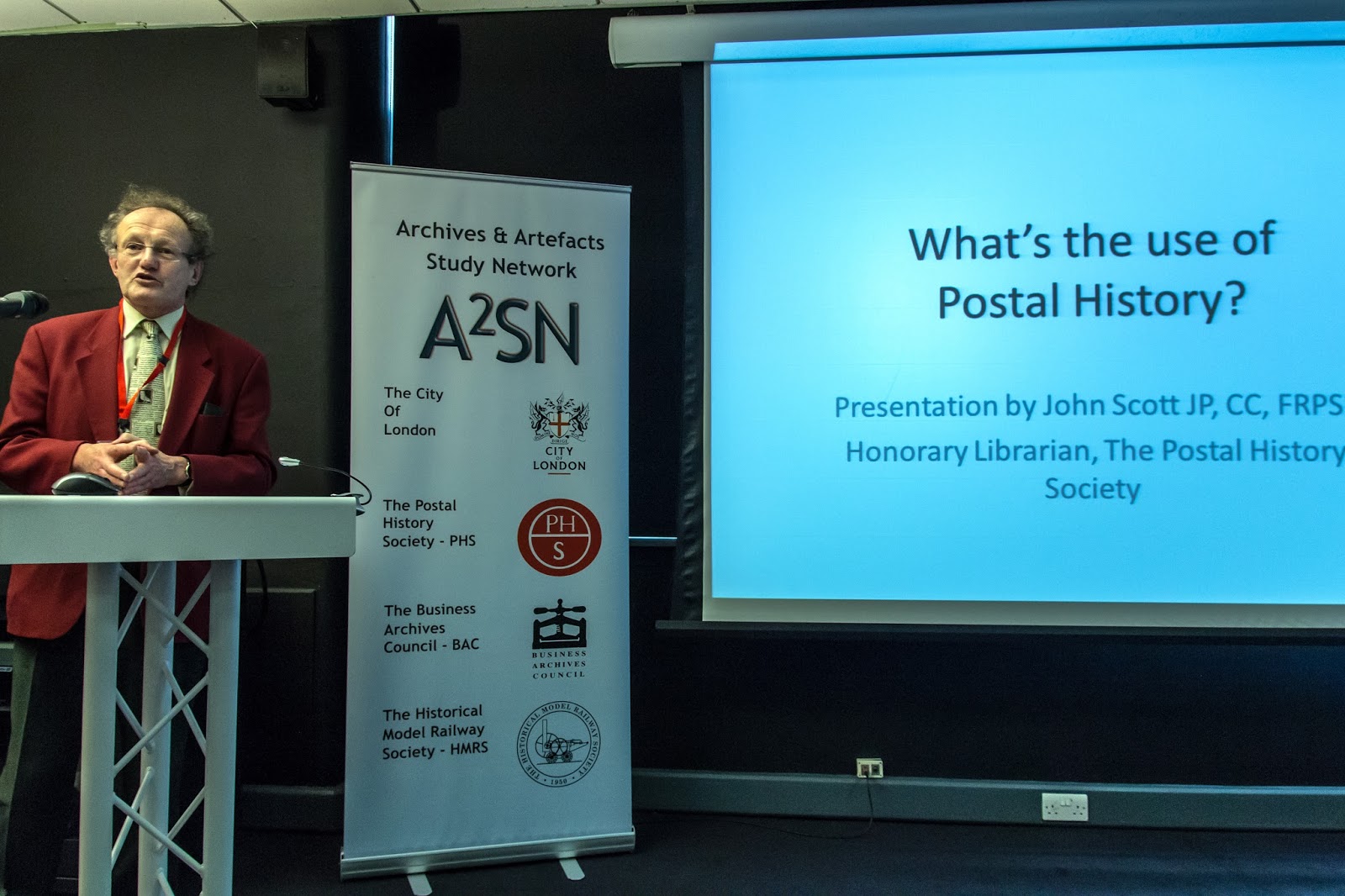
John Scott
of the Postal History Society related a rags to riches story running from how
poor people used to collect rags to sell for the making of paper through to the
entrepreneurs who used the paper. As John said, “When you open a letter, at
least in those glorious days before the advent of the envelope enabled the
recipient to throw half the story away immediately, you may be lucky enough to
stumble across a sample of the actual fabric produced all those years ago. Because it has been shut away from light ever
since it was made, the colours and the texture can be as pristine as the day
they were made.” With the help of his wife Claire he passed round
actual samples of cloth from the nineteenth century which had survived in many
cases pinned to letterheads, hence they were filed with other business
correspondence. To hear about, see and handle these artefacts was a really
great experience.
 The following presentation linked neatly in to the experience of having
handled 19th Century textiles.
Steve Toms of Leeds University, gave a really interesting business
orientated view of “Cotton Textiles in the British Industrial Revolution.” Discussing “How profitable were the firms?”
Steve noted that much of the economic history research into textile firms of
this era had been done on a relatively small set of data. Some six or seven
company’s records had survived intact and it was upon these that much of the
research had been based. He also covered child labour, laissez faire doctrine, free
trade, technology and innovation. The presentation showed how these issues were
inter-related and how archival evidence can be used to resolve conflicting
interpretations. Steve also discussed the impact of hours worked in the mills
on the profits returned. He concluded
that the working week could have been restricted to 58 hours whilst still
maintaining an adequate (i.e. greater than 10%) rate of return on capital while
having led to around a 3.5% increase in unit costs. However, contrary to the
claims of some 19th century pundits, when analysed objectively, unit
labour costs in Britain were 36% lower than continental Europe, hence the threat
of foreign competition was not so great at that time.
The following presentation linked neatly in to the experience of having
handled 19th Century textiles.
Steve Toms of Leeds University, gave a really interesting business
orientated view of “Cotton Textiles in the British Industrial Revolution.” Discussing “How profitable were the firms?”
Steve noted that much of the economic history research into textile firms of
this era had been done on a relatively small set of data. Some six or seven
company’s records had survived intact and it was upon these that much of the
research had been based. He also covered child labour, laissez faire doctrine, free
trade, technology and innovation. The presentation showed how these issues were
inter-related and how archival evidence can be used to resolve conflicting
interpretations. Steve also discussed the impact of hours worked in the mills
on the profits returned. He concluded
that the working week could have been restricted to 58 hours whilst still
maintaining an adequate (i.e. greater than 10%) rate of return on capital while
having led to around a 3.5% increase in unit costs. However, contrary to the
claims of some 19th century pundits, when analysed objectively, unit
labour costs in Britain were 36% lower than continental Europe, hence the threat
of foreign competition was not so great at that time.
The Leeds
Locomotive Industry was next and we heard from Don Townsley. The start
of locomotive production in Leeds was Blenkinsop’s and Murray’s locomotive in
1812 for the Middleton Colliery Railway which was the first commercially
successful locomotive in the world. This
was beginning of a process where numerous firms were to build 11,000 Steam and 19,000 diesel locomotives in Leeds. Locomotives that started life in the city reached railways from the
Urals to the Cape, the Andes to the Antipodes, and from 15,000 feet above sea
level to two miles below ground. Don
concluded that some 60 per cent of the Leeds’ locomotive production was
exported. The history of any large engineering district is always complex and
companies are inter-related because people from one move to another, or leave
and found their own. The district of
Hunslet became a hub where in 1837, one of Murray's former apprentices, Charles Todd,
had formed a partnership with James Kitson to create a locomotive factory,
later known as The Railway Foundry, in Pearson Street, Hunslet with financial
backing from David Laird, a wealthy Scottish farmer. Todd, Kitson & Laird's first order was
for six locomotives for the Liverpool & Manchester Railway. The most famous
of the six was ‘Lion’ for the Liverpool & Manchester Railway 1839 aka ‘The
Titfield Thunderbolt’ and now with Liverpool Museum. The industry continued to develop and
consolidated around E.B. Wilson’s Railway Foundry, however this too passed out
of existence in a shareholder’s dispute of 1858. From the remains of the Railway Foundry rose
the Leeds Locomotive Industry in the form in which it is best currently
remembered, comprising the firms of Manning Wardle & Co., Hudswell Clarke
& Co., John Fowler & Co., Kitson & Co., The Hunslet Engine Co. and Greenwood & Batley Ltd. Eventually all these companies were acquired
by The Hunslet Engine Co (as Hunslet Holdings plc.) at intervals up to 1980.
Don concluded “…in 1987 the Leeds Locomotive Industry in the form of Hunslet
Holdings plc. ceased to be a family run concern and became part of an
international group.”

Probably the best known of the various traction
engine manufacturers in Leeds was John Fowler who was a Quaker. However, when Fowler came on the scene in
1852, his inventions in respect of agricultural improvements, including
windlasses and drainage ploughs, required the construction of his design of
steam ploughing engines and until he established his own works in Leeds in
1862/3, early engines to his design were built for him by Robert Stephenson
& Company in Newcastle, Clayton & Shuttleworth of Lincoln and in Leeds
by Kitson & Hewitson. Fowler’s Steam
Plough Works turned out their first engine around 1862/3. As a result of stress coming from the
setting up of the factory, Fowler himself suffered something of a nervous
breakdown and was advised to move to the country. He did this in mid-1864, to Prospect House,
Ackworth and he took up country pursuits.
He was out hunting in the November, fell from his horse, caught tetanus
and subsequently died - aged only 38 – later the same year. There are many more traction engine companies
that Derek mentioned and illustrated. I commend you to his paper in the
Proceedings when they are published. The
links within heavy engineering in Leeds are fascinating and it was good to get such
a clear picture of just how intertwined the rail and road engine manufacturers
were.
Anthony
Coulls from The National Railway Museum reinforced Don Townsley’s point that
much of the heritage of Leeds railway manufacturers is perhaps more important in
the international context. He noted “It would be difficult to look internationally at
every location where a Leeds built vehicle remains, but by accident of
circumstance, I have been involved with the preservation of a quantity of Leeds
equipment in West Africa and thus felt it appropriate to look in a bit more
detail at the Sierra Leone story. Leeds and the railways of that country have
been inextricably linked since 1896.”
The railways
of Sierra Leone were surveyed by English engineers and constructed and opened
in 1897, the very first locomotives being six wheeled tank engines built by
Hunslet in Leeds. As the line extended, the six wheeled locomotives were
relegated to shunting or use on the steeply graded Mountain Railway. In 1906,
the first Hunslet 2-6-2 tank locomotives were built, of a basic design that was
to serve the railways of Sierra Leone until their eventual closure almost 70
years later. Other British manufacturers also supplied locomotives and rolling
stock. In the 1950s the last steam locomotives
were ordered from Hunslet and Hudswell Clarke began to supply diesels. Other
Leeds built equipment was also hard at work underground in the gold, diamond
and iron ore mines. Anthony has been advising Sierra Leone’s own National
Railway Museum which has gathered rolling stock that survived the civil war.
The SLNRM opened to the public in 2005 after a year’s hard work by locals and
Colonel Steve Davies, then serving in Sierra Leone as part of a team settling
the country after the conflict. Of the vehicles in the museum, six of the
locomotives are Leeds built – two steam and four diesels, a very significant
legacy of a very long tradition. Anthony also showed some wonderful pictures to
illustrate this story
Our
keynote speaker was Alan Kinlay from Newcastle University who spoke on
“Banking, bureaucracy and the career.”
Alan had a fascinating tale of bank clerks, who were exclusively male
until the 1950s. These young men were not allowed to marry without the permission
of the bank, which took a view that they required a salary of £200 per annum to
do so. The expectation of the bank was that they would reach this point in
their careers at some point between 26 and 28 years of age. The banks made
secret appraisals of the clerks which were written in ledgers. Good entries were penned in black and bad in
red. Because the entries were in ledgers they survive in business archives
where Alan had found them.
Having
laid out the employment conditions for bank clerks, Alan went on to illustrate
how these impacted on the individual, focussing particularly on the case of
William Notman and his attempt to get married, which included going to the
managing director of the bank and pleading to be allowed to do so, but failing.
William, determined not to be so caged went ahead and married the lady of his
choice only to have his employment immediately terminated. He desperately
sought work for three years, then took the bank to court and won £1000 damages,
though he never again worked in a bank. As Alan said, “Mr Notman’s experience
speaks of how the bank sought to make a
specific type of man, not just an employee.
The timing, even the possibility, of full manhood was dependent upon the
bank’s sanction.” The employment of
females in banks came much later and this was also discussed, reaching the
conclusion that: “For most of the 20th Century men and women occupied the same
organisations, but remained in quite distinct internal labour markets.”
This was a
fascinating keynote which made me think of employment conditions generally. The
railways, for example, did not initially have workers, they were railway
servants and were required to live at an address approved by the railway. Not quite as draconian as a marriage bar, but
not entirely dissimilar.
The workshop sessions over many of us repaired to an excellent
pre-ordered meal at the Aire of the Dog situated on Cardigan Fields Complex
just off Kirkstall Road. An good time
was had by all as the photos show. Many thanks to Ann Martin, the Manager of
the pub and her staff for their excellent service.
Day 2
began by continuing the railway theme from the previous afternoon. The Workshop heard from Ian Drummond and
Jonathan Stockwell, the authors of a book on the Derwent Valley Light Railway
which was opened in 1913 and operated for 80 years from Layerthorpe in York to
Cliff Common. It did some top secret work during WW11 and was never
nationalised. Part of the line is retained as part of the Yorkshire Museum of
Farming at Murton. Only 3 coaches owned
by the railway that ever ran on it were 4 and 6 wheelers, though it
experimented in 1924 with a pair of Ford Railbuses. This amazingly little
railway owed its survival to its flexible attitude to business, taking whatever
railway traffic presented itself where and when it could and investing in more
land than it really needed so that it had a “land bank” which could be let out
or sold as circumstances demanded. The
book gives a company history and many photographs and maps; highly recommended!
Jane
McCutchan from the Museum of English Rural Life gave us a very interesting talk
on her journey through attaining her PhD at Reading. In 2009, The Museum of
English Rural Life had advertised a scholarship for someone to undertake a
three year investigation into the steam mechanisation of agriculture,
1840-1920, leading to the award of a PhD. Jane applied and won the chance to go
for it. Funding for the project was given by a benefactor, ‘Enthusiast’, and
owner of a ‘portable’ engine, who felt the topic was under-estimated by
academics and the general public. The major purpose of Jane’s research was to
examine the spread of steam ploughing engines during the period 1860-1930 to
identify what was governing the rate of adoption of steam-based agricultural
machinery and if the extent of diffusion was reasonable. She spoke very
knowledgably but also practically. Here
was a PhD candidate with a purpose who was not afraid to travel huge distances,
spend a large amount of time with enthusiasts and others who understood steam
engines and to get her hands dirty. Jane
has shovelled coal, dismantled engines and cleaned smoke boxes. She showed a
practical as well as an academic understanding of her topic and had the twinkle
in her eye of someone who loved her subject
Paul Jordan gave a fascinating paper on tracing the history of
“Criollo”– a 2-4-0 inside cylinder side tank railway locomotive situated and seemingly
built in Uruguay. Paul discovered that Criollo appeared to have been
designed by Allan Darton and completed in
June 1895 at the workshops of the North Western of Uruguay Railway (NWUR), a
British company. Thought to be the first South American built locomotive, she
was in regular service until the 1930s and not finally withdrawn until 1949.
Criollo was first preserved by a Uruguayan novelist in his garden. Later she
was moved to a museum but still sits outside rusting and now stripped of most
of her fittings. The Uruguayan Government asked
the British Uruguayan Society for help in restoring her hence Paul became
involved. In a welcome development, Criollo
was declared a national monument in 2012.
Research at the NRM in the UK led Paul to learn
more about 19th century locomotives. A genealogist friend gave him
references to Allan Darton from the 1861/71 censuses and the
transatlantic passenger records. Allan Darton was educated at Ackworth School,
a Quaker boarding school and Wilson Wordsell, later to become locomotive superintendent of the North Eastern Railway from 1890 to 1910, was his
contemporary at the school. Allan also had an illustrious career, reaching
the General Managership of the NWUR before he retired.
Paul having retired from university teaching in
2009 had more time to research Criollo and discovered that she was probably a
NWUR rebuild of a contractor’s locomotive originally shipped out from England
to build the railway. Amazingly, at heart, Criollo appears to be a Hunslet
locomotive possibly built in Leeds in 1873. Detective work is still ongoing and
the fascinating story so far will appear in the Proceedings.

The HMRS Archive is open to the public, but being volunteer run asks that
prior arrangement is made. It holds some 400,000 historic railway engineering drawings,
including the Metropolitan Cammell Railway Carriage and Wagon Company (major
railway rolling stock manufacturers from 1837 – 1989) drawing collection.
Workshop copy drawings from the Derby Museum Collection, including the Derby
Works collection are also held by HMRS. Recently some 250,000 microfiche
drawings from many different railway stock builders were added to the
collection in a single gift. Enthusiasts too have placed their personal
research and drawing collections with the Society. 28,410 of the above drawings
have been catalogued and are available on the HMRS website. The Archive also
has 1620 railway working timetables, 370 sets of rules and regulations, 530
operating instructions, 200 accident reports, 100 vehicle diagram books and a
large collection of British Railways’ files.
Such is the depth of the collection that heritage railways, preservation
enthusiasts, historians and modelers all use it both in the UK and elsewhere. In
the last two years the HMRS has been able to supply the Railway Preservation
Society of Japan with drawings of the first railway carriages to run there
which were made by Metropolitan Cammell.
Tamara found the Metropolitan Railway and Underground drawings
fascinating. There followed what she described as a “Light Bulb Moment.” In
order to ensure that these and other drawings reached the widest audience, if HMRS were to provide metadata for relevant records
and TfL were to extract the metadata relevant to determining interest; then TL
could standardise metadata according to internationally accepted criteria. The
data could then be included in the TfL catalogue. Agreement
rapidly followed and the metadata is being continually updated by HMRS
volunteers. Tamara is hopeful that it will be available on line via TfL and
hence the Archives Hub by the end of the year. A really great example of a
Corporate Archive that is willing to think “outside the box” and as a result
benefit itself and a charity.
 John
Arkell, HMRS Private Owner Steward, spoke of his research into reconstructing
companies. Having attended the London conference last year he was very
interested in the presentation by Dr Simon Mollan and Dr Kevin Tennant who were
explaining the way they researched companies when no company records remain. As
he listened to them the thought crossed his mind that this was exactly what he
had been doing for at least fifteen years whilst researching the coal trade in SE
England for model making purposes. John is a model maker with a particular
interest in those private companies who operated their own wagons on the
railway prior to nationalisation in 1948. Over time he has refined his
questioning on companies owning wagons looking at who owned wagons, what
stations they were based at, when and for how long the company was in business,
numbers of wagons owned, liveries carried, sources of supply and what effect
business failures or take-overs had? His best direct evidence came from original
photographs as many of the wagons carried not only company names but also
addresses. Aside from these records of wagon registrations as well as Railway
Clearing House records, wagon builder’s order books as well as commercial and
amateur recorders’ sketches have also been of use. Local Directories and Newspaper
advertisements, The London Gazette archives, The Colliery Year Book and Coal
Trade Directory as well as the Coal Merchant and Shipper magazine held at the
British Library also yield good source material.
John
Arkell, HMRS Private Owner Steward, spoke of his research into reconstructing
companies. Having attended the London conference last year he was very
interested in the presentation by Dr Simon Mollan and Dr Kevin Tennant who were
explaining the way they researched companies when no company records remain. As
he listened to them the thought crossed his mind that this was exactly what he
had been doing for at least fifteen years whilst researching the coal trade in SE
England for model making purposes. John is a model maker with a particular
interest in those private companies who operated their own wagons on the
railway prior to nationalisation in 1948. Over time he has refined his
questioning on companies owning wagons looking at who owned wagons, what
stations they were based at, when and for how long the company was in business,
numbers of wagons owned, liveries carried, sources of supply and what effect
business failures or take-overs had? His best direct evidence came from original
photographs as many of the wagons carried not only company names but also
addresses. Aside from these records of wagon registrations as well as Railway
Clearing House records, wagon builder’s order books as well as commercial and
amateur recorders’ sketches have also been of use. Local Directories and Newspaper
advertisements, The London Gazette archives, The Colliery Year Book and Coal
Trade Directory as well as the Coal Merchant and Shipper magazine held at the
British Library also yield good source material.
It was
obvious that John’s research had travelled far into business history, but he
had not stopped there. Tracking the
names of companies he strayed into genealogy. He finished this excellent
session by saying: “One family I visited still has the company’s ledger books
going back to 1862 and the founding of the firm. I advised them of the rarity
of this information and urged them not to put anything into a skip but to
donate it to a record office.” John is publishing a book on his research, hopefully
later in 2014.
Coal continued as a topic with Coal Stories from Scotland’s Coal Mining Oral History Collections by Helen Foster the education officer for The Scran Trust which aims to provide educational access to digital materials representing our material culture and history. The Scottish Coal Collections Group (SCCG) was established by representatives from over 30 organisations who hold material relating to coal mining in Scotland. It exists to gather collection level descriptions for as many of these collections as possible and has created a website to provide a single point of reference for researchers interested in this important aspect of Scotland’s industrial past, as well as for professionals working with coal mining collections.
Coal Stories, an initiative of SCCG, aims to take this a stage further and has set up a mechanism to host and make accessible digitally recorded oral history material about Scotland’s coal mining heritage. A pilot phase has been developed by partners from the Royal Commission on the Ancient and Historical Monuments of Scotland (RCAHMS), the National Mining Museum Scotland (NMMS) and East Lothian Museums Service in collaboration with Scran (www.scran.ac.uk). Coal Stories is looking to source relevant digital oral history material held by institutions and individuals with coal collections across Scotland. The partnership nature of the initiative creates the potential to showcase a multiplicity of voices and give a full representation of the complexity of the coal mining industry and its heritage. The material will be hosted by Scran with links to contributing institutions, and will be promoted as a valuable educational resource. Scran, a digital service of RCAHMS, is a learning website offering cross-searchable access to a vast library of images, videos and sounds from museums, libraries, galleries, archives, media and private collections. The service is already used by teachers and students in primary and secondary schools, colleges and universities. Access is also available through a large number of Scottish local library authorities. Helen gave fascinating examples of actual oral history as well as demonstrating its power as an interdisciplinary resource and showing how Scran wanted to extend Coal Stories and to embrace the oral histories of other aspects of Scotland’s industrial heritage.
Coal continued as a topic with Coal Stories from Scotland’s Coal Mining Oral History Collections by Helen Foster the education officer for The Scran Trust which aims to provide educational access to digital materials representing our material culture and history. The Scottish Coal Collections Group (SCCG) was established by representatives from over 30 organisations who hold material relating to coal mining in Scotland. It exists to gather collection level descriptions for as many of these collections as possible and has created a website to provide a single point of reference for researchers interested in this important aspect of Scotland’s industrial past, as well as for professionals working with coal mining collections.
Coal Stories, an initiative of SCCG, aims to take this a stage further and has set up a mechanism to host and make accessible digitally recorded oral history material about Scotland’s coal mining heritage. A pilot phase has been developed by partners from the Royal Commission on the Ancient and Historical Monuments of Scotland (RCAHMS), the National Mining Museum Scotland (NMMS) and East Lothian Museums Service in collaboration with Scran (www.scran.ac.uk). Coal Stories is looking to source relevant digital oral history material held by institutions and individuals with coal collections across Scotland. The partnership nature of the initiative creates the potential to showcase a multiplicity of voices and give a full representation of the complexity of the coal mining industry and its heritage. The material will be hosted by Scran with links to contributing institutions, and will be promoted as a valuable educational resource. Scran, a digital service of RCAHMS, is a learning website offering cross-searchable access to a vast library of images, videos and sounds from museums, libraries, galleries, archives, media and private collections. The service is already used by teachers and students in primary and secondary schools, colleges and universities. Access is also available through a large number of Scottish local library authorities. Helen gave fascinating examples of actual oral history as well as demonstrating its power as an interdisciplinary resource and showing how Scran wanted to extend Coal Stories and to embrace the oral histories of other aspects of Scotland’s industrial heritage.
Keith Harcourt, HMRS Academic Liaison Officer, closed the
conference with a paper on Passengers, Freight and Containers 1830 – 1959. Keith
looked at the beginnings of railways in
the United Kingdom driven by a need to move freight and how their traffics
developed. He discussed the ways in which the customs and practices of the
people of the country drove the commercial development, the explosion of railway
use and the unitisation of freight.
Keith
also showed how government intervention and the development of road haulage
impacted on the development of railways. The concept of gathering freight
together and in the technical sense “unitising” it was developed as a response
to commercial pressures.
Our thanks
go to Keith who organised the weekend alongside Roy Edwards. Look out for
publicity soon on both the 2015 Conference which will be held in Ironbridge at
the end of May and a Workshop which will be in Reading at a location which will
be confirmed soon. I can assure you of a good weekend at both.
Margaret
Garratt – Secretary of the HMRS


.jpg)